the central processing unit is the 'brains' of the computer, it is a small chip on the motherboard executing instructions processing data perform calculations, acting as the control unit.
The principal components of a CPU are:The CU uses the fetch-execute cycle (fetch decode execute), and then calling on the ALU when needed. CU controls and monitors the system hardware commands are executed. Final thing, it controls input and output of data.
The ALU gathers data from input resisters, and performs operations of the stored data to make an output. addition, subtraction, multiplication, division, even >,<,=, AND and OR operations.
Registors are temporary high speed data storages that are needed for quick executions for the CU. All data must be stored in the registor before processing.
There are different types of registers with their own purposes.

Processors have a property called clock speed, which is the speed at which it executes instructons. The greater it is, the more instructions it can execute per second.
Clock speeds are measured in hertz Hz, usually expressed in megahertz or gigahertz (MHz, GHz). A modern computer can run at 2.7GHz (2.7x2^30) clock cycles/s. It is carrying out 2.7bil instructions/s.
sometimes referred to as immediate access storage (IAS), is the internal storage area of the computer that can be directly addressed by the processor. It holds programs and data the user is using.
The processor reads the data from a backing storage (harddisk, flash drive etc), stores temporarily in memory. Backing storage is too slow for running applications directly. Processor extracts the instructions fro memory, decode, executes them.
There are two types of memory - read-only and random access.
Read-only memory (ROM) is permanent. It can't be altered by the user, advantage being that its non-volatile (preserved when the computer shuts off). It is used for fixed programs like start ups.
Random access memory (RAM) is temporary. it is volatile, contents are lost during shut down, therefore data and programs must be loaded into RAM every start up. RAM is measured in MB or GB, the more RAM the faster it responds.
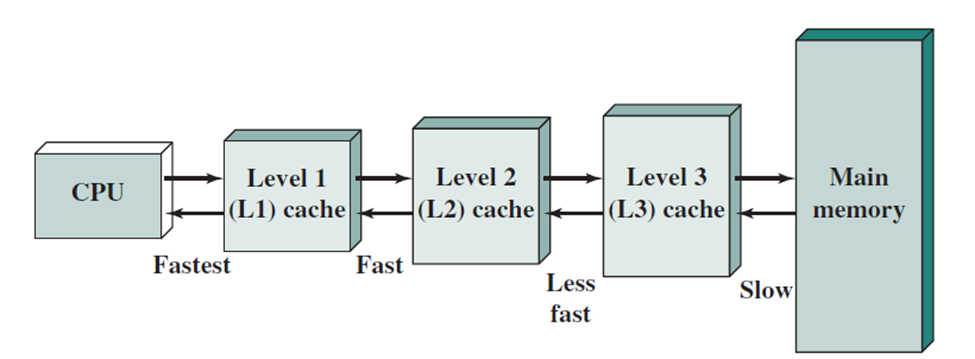
Cache memory (sometimes called CPU memory) is a special memory which can be accessed faster than RAM. However, it is much more expensive.
It holds information like sections of a program and its associated data that the computer uses frequently. Cache 'reads ahead' when the CPU first accesses a particular memory, cache controller predicts which addresses are likely next and pre-fetch it.
Cache memory performs two tasks - to store frequently used instructions, and to 'read ahead'.
Cache controller transfers data from RAM into the cache. If the CPU needs information, it goes thru a process
(insert image here later)